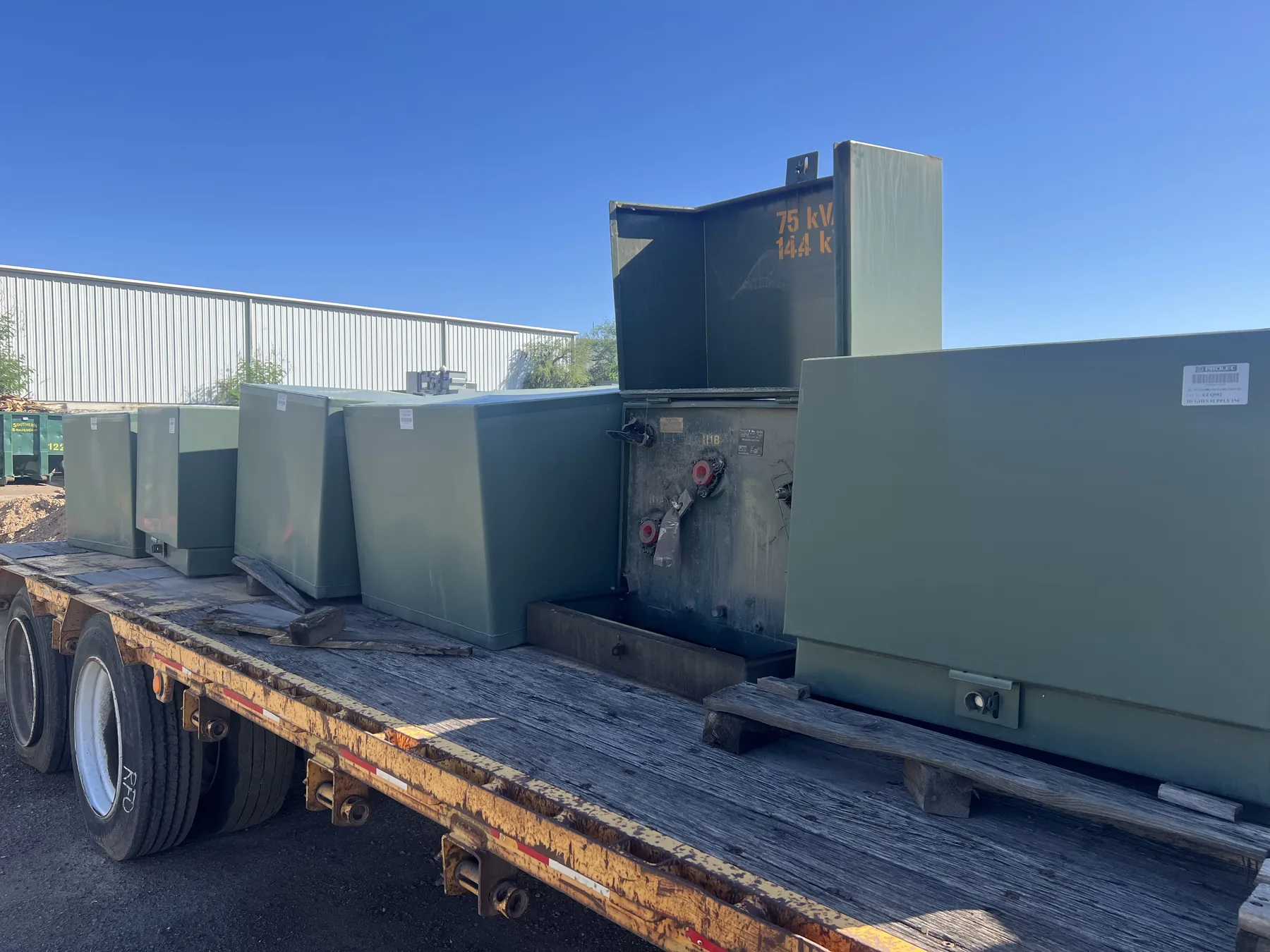
Identify the padmount before discussing price
Pad-mounted transformers are self-contained, ground-level units used throughout commercial developments, campuses, industrial sites, renewable projects, and utility distribution systems. A seller may have a new-surplus unit left from a project, a stored spare, an operating unit scheduled for replacement, or a retired transformer already disconnected. The same outside appearance can conceal very different ratings and commercial prospects.
Send the manufacturer, serial number, date, phase, kVA, primary and secondary voltage, impedance, cooling class, fluid type if shown, and weight when available. Also identify radial- or loop-feed configuration when it is known from the nameplate or records. Do not open an energized cabinet or rely on a handwritten yard label as a substitute for the manufacturer plate.
Document cabinet, component, and fluid condition
Exterior photos should show doors, hinges, locks, paint, radiators, bushings, gauges, pressure-relief devices, valves, and the base. Point out corrosion, impact damage, missing hardware, broken bushings, evidence of leakage, fire exposure, flooding, or unauthorized modifications. State whether the unit is sealed, drained, partially drained, or believed to contain its original fluid; do not sample or drain it merely to complete the form.
If the transformer was removed from service, explain why and when. Available test records, maintenance files, oil documentation, and storage history can reduce uncertainty. A unit stored indoors on suitable blocking presents a different review from a unit that has sat exposed to standing water or has open compartments.
Ratings, completeness, and demand influence market fit
Padmount value is not a simple function of size. Common or project-relevant ratings, complete cabinets and accessories, clear identity, documented condition, and practical transportation can improve commercial fit. Unusual voltage combinations, missing components, uncertain ownership, contamination concerns, severe damage, or difficult removal may limit options or require further review.
A buyer may evaluate the transformer for direct reuse, testing and resale, remanufacturing, parts, material recovery, or another approved path. The intended path affects the information required and the commercial terms. Sellers should avoid advertising a used unit as tested or service-ready unless qualified records support that description.
Show the route from the pad to the truck
Installed padmounts can sit behind fences, landscaping, curbs, bollards, energized lines, narrow drives, or soft ground. Access photographs help determine whether a forklift, crane, rollback, specialized trailer, or other equipment might be needed. Include approximate dimensions and weight from the plate or drawings when available, plus gate widths, overhead clearances, and any site scheduling restrictions.
The written proposal should state whether the seller or buyer handles electrical disconnection, fluid work, rigging, loading, freight, permits, and restoration. Site work must be performed by appropriately qualified parties under the owner’s safety rules. A quote request does not authorize field work.
Use a complete submission to reduce contingencies
A complete packet allows the buyer to compare the padmount’s specifications and condition with current needs and logistics costs. If additional information is required, the response can focus on a specific unknown rather than restarting the inquiry. When an offer is made, read the equipment description, quantity, location, responsibilities, timing, and any inspection conditions carefully.
The fastest submission is the accurate one. Send what is known, label uncertainty clearly, and avoid assumptions about PCB status, fluid type, operating condition, or weight. Our offer-request page organizes the common fields and provides a direct route to a commercial review.